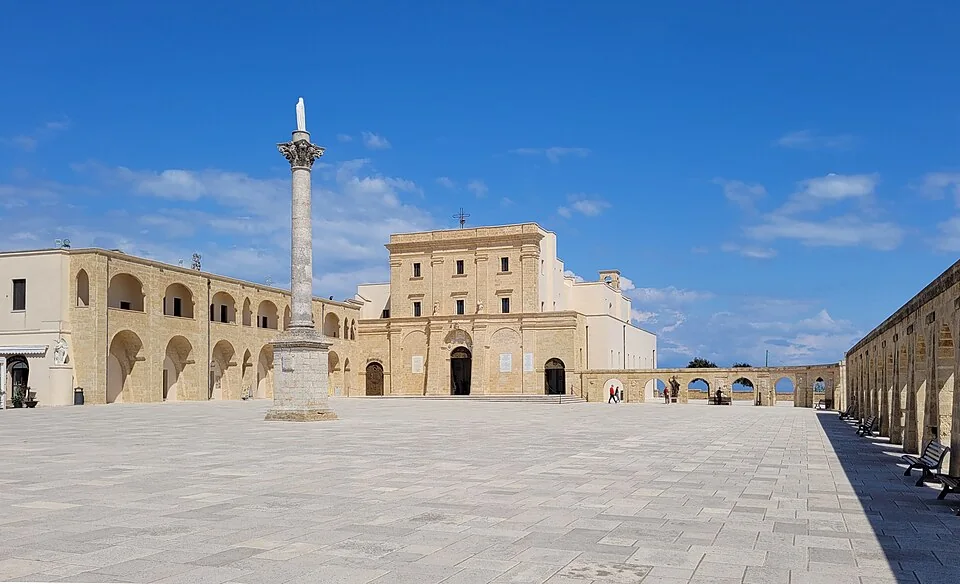
The Santa Maria di Leuca Sanctuary, known as the Santa Maria de Finibus Terrae Sanctuary, stands at the southern end of Salento, in one of the most evocative and symbolic places in the Capo di Leuca.
Its history spans centuries of devotion, pilgrimages, raids and reconstructions. According to local tradition, however, the sacred history of this promontory goes back even further, to a time when a place of worship dedicated to the goddess Minerva is said to have stood here.
Over the centuries, this strip of land overlooking the Mediterranean has continued to be regarded as a special place: first associated with pagan worship, then with the tradition of Saint Peter’s arrival and, finally, with the Marian devotion that made Leuca an important pilgrimage destination.
To truly understand the Santa Maria de Finibus Terrae Sanctuary, therefore, it is worth looking beyond the building we see today and discovering the stories that have accumulated on this promontory over the centuries.
Finibus Terrae: at the End of the Land
The name itself tells us something about the extraordinary location of the Sanctuary.
Finibus Terrae evokes the idea of the “ends of the earth”, reflecting Leuca’s position at the southern tip of the Salento peninsula.
For pilgrims who reached this place on foot in centuries past, travelling along roads and paths through the countryside, arriving at the Sanctuary meant finally standing before the sea, where their journey over land seemed inevitably to end.
But Leuca was also a place of passage. Stretching out into the Mediterranean, its position placed it along routes connecting East and West.
This dual character — the end of a journey and a meeting point between different worlds — has accompanied the history of Santa Maria de Finibus Terrae for centuries. Pajara alle Macchie
Before the Sanctuary: the Cult of Minerva
Local tradition traces the sacred character of the promontory back to a period long before the establishment of the Christian Sanctuary.
According to a story handed down over the centuries, a temple dedicated to the goddess Minerva once stood on the promontory.
The Basilica still preserves a reminder of this tradition. Inside, on the right, there is a stone element traditionally identified as an altar, or part of an altar, on which sacrifices may once have been offered to the goddess.
The location would have been significant. The promontory was a natural landmark for those travelling across the Mediterranean, and the relationship between the high ground, the sea and navigation gave this extreme edge of the peninsula a powerful symbolic meaning.
The story of the Temple of Minerva becomes even more fascinating when considered alongside the later Christian tradition.
According to the story preserved in Leuca, the Sanctuary inherited the sacred character of a place that had already been considered holy before Christianity arrived.
Historical and archaeological evidence does not allow every event from this distant period to be reconstructed with certainty. The Temple of Minerva should therefore be understood as part of the tradition surrounding Leuca, rather than as an entirely documented historical fact.
And it is on this ancient sacred site that tradition places another fundamental episode in the history of Leuca. Pajara alle Macchie
Saint Peter’s Passage and the Beginning of Christian Worship
According to Christian tradition, Saint Peter landed at Leuca after travelling from the East, during the journey that would eventually take him towards Rome.
His arrival is traditionally associated with the Christianisation of the ancient place of worship: the pagan sanctuary is said to have become one of the first places in the area dedicated to the new faith.
The story has a powerful symbolic meaning. At the southern end of the Salento peninsula, facing eastwards, the arrival of the Apostle represents the transition from the ancient cult to Christianity.
The Petrine Cross, which can still be seen in the Sanctuary area, commemorates this tradition.
There is no contemporary historical evidence confirming Saint Peter’s journey through Leuca, and the Sanctuary itself presents it as a tradition. Nevertheless, the story has played an important role in the religious memory of the area and in the later history of pilgrimages to Finibus Terrae. Pajara alle Macchie
Santa Maria de Finibus Terrae and Marian Devotion
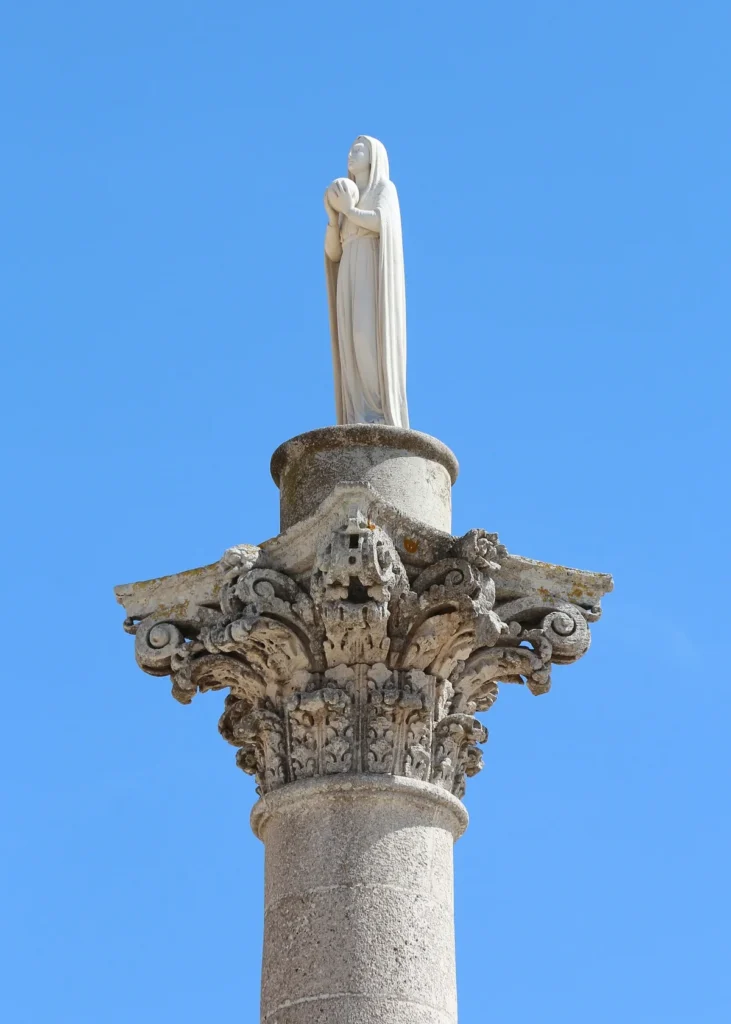
As Christianity became established, the history of the promontory became increasingly associated with the Virgin Mary.
Over the centuries, Marian devotion became central to the identity of the Sanctuary and one of the main reasons why pilgrims travelled to Leuca.
Its location overlooking the sea gives this devotion a particular character. For centuries, the communities of the Capo di Leuca lived in close contact with the Mediterranean. Fishermen, sailors, merchants and coastal communities were constantly exposed to storms and the dangers of navigation.
It is therefore not surprising that the symbolic relationship between the Virgin Mary and the sea became particularly strong here.
This connection also appears in one of the oldest traditions associated with the Sanctuary. Pajara alle Macchie
13 April and an Ancient Tradition of Leuca
According to local religious tradition, on 13 April 365, a violent storm threatened Leuca and the surrounding communities.
The inhabitants are said to have invoked the protection of the Virgin Mary, after which the storm subsided.
The story belongs to devotional tradition, and there are no contemporary sources that allow us to reconstruct the event historically.
Its importance lies primarily in the memory it created.
For generations, this story helped strengthen the connection between Santa Maria de Finibus Terrae, the sea and the communities of the Capo di Leuca, becoming part of the area’s religious and popular heritage.
And it is precisely this devotion to the Virgin Mary that leads us to one of the most important works preserved inside the Basilica. Pajara alle Macchie
The Image of Santa Maria de Finibus Terrae
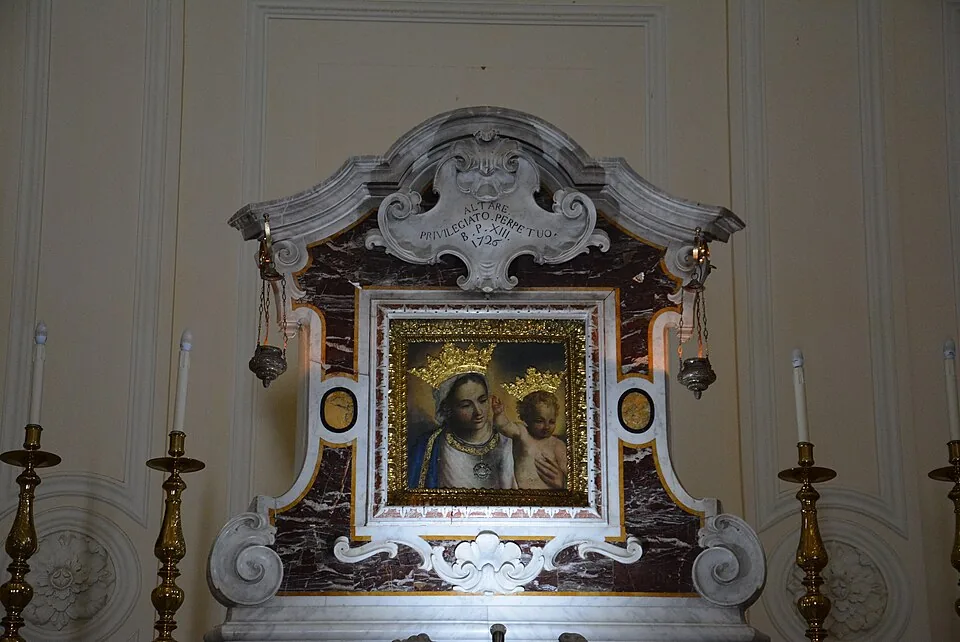
The main altar houses an image of the Virgin and Child, attributed to Jacopo Palma il Giovane, also known as Palma the Younger.
The history of the painting is closely connected to the troubled history of the Sanctuary itself.
According to the tradition preserved by the Basilica, previous images were destroyed, while the work by Palma the Younger was commissioned by Bishop Giacomo Del Balzo in the 16th century.
Even this painting has not survived intact.
The image visible today was originally part of a larger painting that was partially destroyed by fire during one of the attacks on the Sanctuary in the first half of the 17th century.
What we see on the main altar today is therefore more than a religious image.
It is also a physical reminder of the destruction endured by the Sanctuary.
While the building was attacked, damaged and subsequently rebuilt, the image of the Virgin continued to be a point of reference for the communities travelling towards Finibus Terrae. Pajara alle Macchie
A Sanctuary Destroyed and Rebuilt
The same position overlooking the Mediterranean that made Leuca a meeting point also exposed it to attacks from the sea.
The history handed down by the Sanctuary speaks of five destructions followed by five reconstructions.
For the more recent periods, more precise documentary evidence is available.
In 1624, the medieval church was destroyed by Algerian pirates. The event is remembered in a written account dating from 1643 by Francesco Pirreca.
These raids were not merely a dramatic chapter in the history of the Basilica.
They also explain one of its most unusual architectural features. Pajara alle Macchie
Why Does the Sanctuary Look Almost Like a Fortress?
At the beginning of the 18th century, the Sanctuary was rebuilt once again.
In 1720, Bishop Giovanni Giannelli promoted the construction of the building that essentially forms the core of the present Basilica.
The church was completed in 1740 and consecrated in 1755 by Bishop Dionisio Latomo Massa.
Giannelli, however, adopted an unusual solution.
To help protect the Sanctuary from further attacks, the exterior was designed so that the building would not immediately resemble a large church.
The Basilica therefore acquired the austere appearance of a fortified structure, almost like a multi-storey civil building. Rows of windows reinforced this impression.
It is one of the most interesting details to notice when visiting the Sanctuary.
Its apparently simple façade is therefore not accidental: it reflects centuries of raids and the difficult relationship that Salento’s coastal communities once had with the sea. Pajara alle Macchie
What Can You See Inside the Basilica Today?
Once inside, the contrast with the austere exterior is immediately noticeable.
The interior consists of a single nave with six side altars, while the image of the Virgin and Child dominates the main altar.
The 16th-century internal portal from the previous church has also survived, providing a tangible reminder of the different phases the building has passed through.
The numerous plaques and inscriptions, many of them in Latin, are particularly interesting.
Together, the walls become almost a stone archive, preserving traces of events that wars, fires and destruction have erased elsewhere. Pajara alle Macchie
When Reaching Leuca Meant Undertaking a Journey
Today, reaching the Sanctuary is easy. For pilgrims in the past, it was a very different experience.
Finibus Terrae was a destination reached by travelling along rural roads, paths and routes connecting the small towns and villages of Salento.
Buildings were also constructed near the Sanctuary to accommodate pilgrims, showing how important this movement of people had become.
Their journey crossed the countryside of the Capo di Leuca, a landscape shaped over centuries by agriculture, with olive groves, dry-stone walls and traditional rural stone buildings. Among them, the pajare of Salento are one of the most distinctive examples of the area’s rural architecture.
The journey itself therefore became an integral part of the religious experience.
Pilgrims continued south until the land seemed to end and only the sea remained before them.
It is difficult to imagine a place where the name Finibus Terrae could have had a more tangible meaning. Pajara alle Macchie
A Pilgrimage Tradition That Continues Today
Devotion to Santa Maria de Finibus Terrae was not limited to Leuca.
Over the centuries, the Sanctuary became a destination for communities throughout Salento and for pilgrims travelling from increasingly distant areas.
That vocation continues today.
Modern walking routes through the Capo di Leuca revive, in a different form, the ancient experience of reaching the southern end of the peninsula on foot.
Walking becomes another way of discovering the landscape: passing through villages, countryside, dry-stone walls and old rural roads before finally seeing the sea appear on the horizon.
It is one of the things that makes the Sanctuary much more than simply another tourist attraction. Pajara alle Macchie
From Sanctuary to Minor Basilica
The history of Finibus Terrae also continues into modern times.
By decree of the Congregation for Divine Worship and the Discipline of the Sacraments dated 19 June 1990, the Sanctuary was elevated to the status of Minor Basilica. The Sanctuary indicates 7 October 1990 as the date from which it officially bears the title.
The recognition marked another chapter in the long history of a place that had already welcomed pilgrims for centuries. Pajara alle Macchie
Pope Benedict XVI’s Pilgrimage to Finibus Terrae
Another important moment in the Sanctuary’s recent history came on 14 June 2008, when Pope Benedict XVI visited Leuca.
The Pope visited the Sanctuary, venerated the image of the Virgin and later celebrated Mass in the large square outside.
In his homily, he described his visit to Leuca as a Marian pilgrimage and reflected on the special significance of this extreme edge of Italy and Europe.
His visit brought together once again several elements that have characterised the Sanctuary for centuries: pilgrimage, the relationship with the Mediterranean and devotion to Santa Maria de Finibus Terrae. Pajara alle Macchie
Visiting Santa Maria de Finibus Terrae Sanctuary Today
The Sanctuary can be visited throughout the year.
The experience changes considerably with the seasons. During summer, the promontory is one of the busiest places in Santa Maria di Leuca. In spring and autumn, however, it is often easier to take your time exploring the Basilica, the large square and the surrounding landscape.
Before visiting, it is worth checking the latest opening times and religious services on the official website of the Basilica-Sanctuary of Santa Maria de Finibus Terrae.
After visiting the Sanctuary, there is much more to discover in the town, from the lighthouse and Monumental Waterfall to the historic villas and sea caves. Our Santa Maria di Leuca guide explores these places in greater detail.
From the Sanctuary to the Countryside of the Capo di Leuca
Leaving Santa Maria di Leuca, it takes only a few kilometres for the landscape to change completely.
The coast gradually gives way to countryside, dry-stone walls, olive trees, Mediterranean scrub and old rural stone buildings.
This is the landscape surrounding Pajara alle Macchie, near Torre Vado and just a few minutes by car from Santa Maria di Leuca.
The Sanctuary can therefore become one of the stops during a stay dedicated not only to the sea, but also to the history, villages and rural landscape of the Capo di Leuca. Pajara alle Macchie
Finibus Terrae: Where History Meets Tradition
The history of the Santa Maria de Finibus Terrae Sanctuary does not belong to a single period.
The memory of the ancient cult of Minerva takes us back to the earliest stories associated with the site. The tradition of Saint Peter’s passage tells of the beginnings of Christian worship. Marian devotion, raids and successive reconstructions accompany centuries of Salento’s history.
Some of these events are historically documented; others have been handed down through religious and popular tradition.
Together, they have shaped the identity of a place towards which generations of pilgrims have continued to walk.
To the very end of the peninsula.
To the point where only the sea remains before you.
Finibus Terrae.
Pajara alle Macchie. Nature, tradition, emotion.
Credits
Santa Maria de Finibus Terrae: foto di Mentnafunangann / Wikimedia Commons – CC BY-SA 4.0. Immagine ridimensionata e convertita in formato WebP.
Statua di Santa Maria di Leuca: foto di Bernard Gagnon / Wikimedia Commons – CC0 1.0. Immagine ridimensionata e convertita in formato WebP.
Leave a Reply